
 post@digimark.no
 On a crowded commuter train in Taipei, a student scrolls through LINE with one hand and grips a tote bag with the other. A few stops later, an office worker in Bangkok checks the same green icon before stepping into a meeting. In Tokyo, a family group chat lights up with weekend plans, stickers flying. LINE is not just another messaging app in parts of Asia, it is the place where friendships, school logistics, neighborhood committees, side hustles, and small-business customer service all converge.
That density of daily life is exactly what makes it attractive to scammers. Not because LINE is uniquely insecure, but because it is uniquely trusted. And when trust becomes the default setting, one convincing screenshot can do a lot of damage.
The screenshot era: proof that isn’t proof
The modern scam often comes prepackaged with “evidence.” A friend “confirms” a debt. A boss “approves” an urgent bank transfer. A seller “shows” a tracking number. The proof arrives as an image, not a live conversation: a screenshot of a LINE chat that appears to settle the matter.
The problem is that screenshots are no longer a byproduct of real conversations. They can be manufactured in minutes. Tools like fake LINE chat generators have legitimate uses, from storyboarding social media skits to mocking up a UI in a design meeting, or creating classroom examples without exposing real students’ messages. But in the hands of a scammer, the same convenience becomes a shortcut to credibility. The format looks familiar, the fonts feel right, the timestamps are plausible. People do what they have always done: they trust what looks like a record.
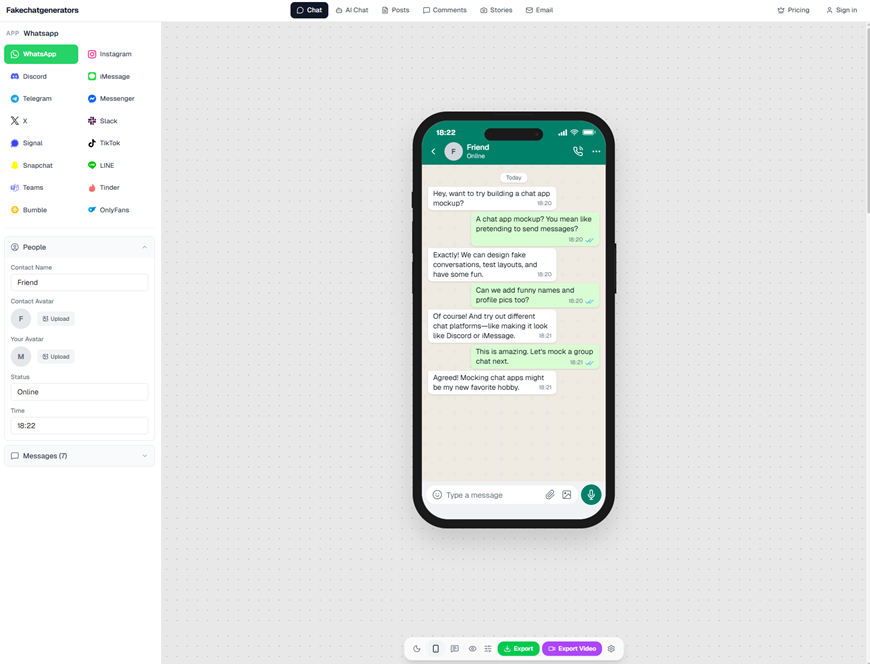
fakechatgenerators.com lets you mock up chat screenshots across 16 platforms
A striking detail in many reported cases is how little the fake needs to accomplish. It does not have to be flawless. It only needs to nudge a target into the next step: click this link, send this transfer, share this code, keep it quiet.
How LINE’s role in the region shapes the risk
LINE’s footprint is not uniform across Asia, which affects how scams play out. In markets where LINE is close to universal for personal communication, the app becomes a stand-in for identity. A message from a familiar display name, paired with a profile photo you have seen for years, carries emotional weight.
Scammers lean on that. They impersonate relatives, colleagues, vendors, or student group leaders. In communities where LINE groups run day-to-day coordination, a single compromised account can ripple through dozens or hundreds of people at once. The scammer does not need to convince strangers one by one. They can exploit an existing web of relationships.
In other markets where messaging is fragmented across multiple platforms, a suspicious message can be dismissed as “not how we usually talk.” Where LINE is the default, there is less friction. The message lands in the right place, at the right time, in the same thread where yesterday’s real conversation happened.
The anatomy of a fake chat scam
Most fake chat scams on LINE share a few beats.
First comes familiarity. The scammer references a shared context, a project name, a family nickname, a club meeting, a recent purchase. Sometimes that context is harvested from a public social profile. Sometimes it is pulled from a hacked account. Sometimes it is guessed. People reveal more than they think in group chats.
Then comes urgency. The request is framed as a small favor with a deadline: “I’m in a meeting, can you do this now?” “I’m at the bank counter.” “My phone is about to die.” The aim is to cut off the target’s instinct to verify.
Next comes the screenshot. It might “prove” that an earlier payment was made, that a supervisor already agreed, or that a third party is involved. In workplace scams, the screenshot often plays the role of internal documentation. In romance and marketplace scams, it acts as a substitute for trust.
Finally comes the pivot to money or credentials: a bank transfer, a QR payment, a gift card code, a one-time password, a login link. At that point, the screenshot has done its job. The target is no longer evaluating authenticity, they are trying to be helpful, or trying to avoid embarrassment, or trying to fix a problem quickly.
Why people fall for it, even when they “know better”
Victims are frequently described as gullible. That misses the mechanics. Many people who get tricked are cautious in other areas of life, and they may have seen warnings about phishing. The scam works because it hijacks social reflexes.
A forged chat screenshot can trigger three powerful assumptions:
- Continuity: it resembles the thread where real conversations happened, so it feels like an extension of reality.
- Consensus: it suggests someone else already confirmed the situation.
- Accountability: it looks like a record you could be judged on later, especially in workplaces.
There is also the awkwardness factor. If you accuse someone of faking a screenshot and you are wrong, you risk damaging a relationship. Scammers understand that social cost and weaponize it.
Detection tools enter the chat, with limits
As synthetic media detection improves, more newsrooms, marketplaces, and trust and safety teams are adding verification steps before content is published or acted upon. Tools like an ai image detector market themselves around speed and scale, with claims such as 98.7% detection accuracy across more than 50 generative models and sub-150ms latency, and they are used by journalists, content moderation teams, banks, and legal groups.
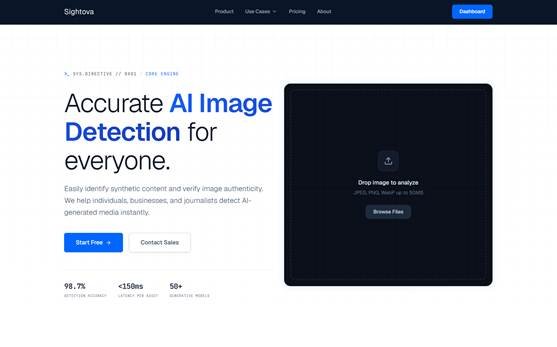
sightova.com flags AI-generated, tampered, NSFW, and violent imagery in milliseconds
That matters because fake chat screenshots are not always “AI-generated” in the popular sense. Some are built with templates, some are edited manually, and some are composites. Detection systems that look for signs of generation or tampering can still be useful, but they are not magic stamps of truth. A clean result does not mean a screenshot is real. A flagged result does not automatically identify who forged it, or why.
For most people, the more practical question is simpler: what can be checked without specialized software?
Verification, the unglamorous antidote
The best defense against fake chat scams is boring, and it works because it breaks the scammer’s timing.
Switch channels. If a request arrives on LINE, verify it elsewhere. Call the person. Use a different app. Ask a question only the real person would answer, ideally something not visible on social media. In families, agree on a phrase or a simple code word for money requests.
Slow the tempo. Scams thrive on urgency. Delay is a form of authentication. A legitimate request can survive ten minutes. A scam often cannot.
Look for behavioral tells, not visual ones. A screenshot can be perfectly styled. But does the request match how your boss normally writes? Does your friend usually ask for a bank transfer without explanation? Is the tone off, even slightly?
Treat screenshots as leads, not evidence. A chat image should prompt a follow-up, not a payment. In many workplace environments, a screenshot of “approval” should be considered insufficient without a direct confirmation.
Harden the account. Use strong passwords, enable multi-factor authentication where available, and be cautious about device changes and login prompts. Account takeovers are a common entry point, and once an attacker controls a real account, screenshots become optional.
The business side: scams in commerce and customer service
Small sellers and service providers have a particular vulnerability on LINE because so much commerce runs through informal chat. A buyer asks for a price, the seller replies, payment details are shared, delivery is coordinated, all in one place. The convenience is obvious. The risk is, too.
Scammers mimic “payment confirmation” images, or send doctored transaction receipts. Some create fake customer service accounts that resemble official ones, complete with logos and formal language, then pressure users into sharing verification codes. When disputes arise, victims often point to screenshots as proof, which can make resolution harder. Platforms and banks tend to prioritize system logs and transaction records, not images that can be forged.
For small businesses, a practical policy helps: never accept screenshots as proof of payment, only confirm through the actual bank or payment app. Repeat it so often that customers expect it.
What this means for LINE, and for the region
LINE did not create the fake screenshot problem. It inherited it from a broader shift in how people communicate and how “proof” is exchanged. But because LINE functions as a social operating system in several Asian markets, the consequences can be disproportionate. A convincing fake chat can travel quickly through tightly connected communities, and the losses are not only financial. Relationships get strained. Workplace trust frays. People become hesitant to help, even when the request is real.
The immediate future looks like an arms race: easier fabrication, better detection, and more social engineering in the middle. The longer-term fix is cultural as much as technical. People need permission to verify without feeling rude. Employers need clear rules that protect staff from “urgent” transfer requests made over chat. Families need simple agreements that reduce panic.
A screenshot used to be a shortcut to truth. On LINE, across much of Asia, it has become something else: a persuasive prop. The sooner users treat it that way, the fewer people will be paying for someone else’s performance.